Trending

Dale's new roundabout has been open long enough for the novelty to wear off and the habits to set in. Some of those habits are fine. Others are the reason you had to brake hard on a Tuesday morning with a coffee in the cupholder. Roundabouts are simple by design — yield on the way in, keep moving inside, signal on the way out — but simple and familiar are different things, and most of us learned to drive at four-way stops and protected left turns. What follows are the mistakes I see most often at the circle, and what the rules actually ask of you.
The yield sign at each entrance means one thing: traffic already in the circle goes first. It does not mean slow down and see what happens. Approach at a speed that lets you stop if you have to, and look left — at the circulating lane, not at the car behind you in the mirror. If there's a gap, take it with confidence. If there isn't, stop.
When you do stop, stop before the yield line. Parking on top of the crosswalk puts you in a pedestrian's path, and creeping into the circle before there's room is how you end up stopped in a spot nobody expects a car to be. Also worth saying plainly: the yield line is not a merge lane. You are not owed a gap because you've been waiting.
Yield doesn't mean creep forward and hope. It means wait, then go.
Every few days somebody stops in the middle of the circulating lane and waves a waiting driver in. It feels generous. It isn't. The driver behind you isn't expecting a stop, the driver being waved at may not trust it and sit there anyway, and if they do go, they're relying on a stranger's read of traffic they can't see.
Traffic in the circle has the right of way. The entrances yield. Keep moving until your own exit, then leave. At a roundabout, courtesy is predictability — doing the thing everyone else is expecting you to do.
If the roundabout has more than one lane, the most important decision you'll make happens a hundred feet before you get there. Read the signs and the pavement arrows on approach; they tell you which lane serves which exit. Where the signing lets you choose either lane, pick the one that matches where you're going and stay in it all the way through.
What you should not do is change lanes inside the circle. There are no lane markings to guide you, the drivers beside you are watching their own exit rather than you, and the geometry leaves almost no room to react. If you realize you're in the wrong lane, go all the way around and come back to your exit. An extra lap costs you fifteen seconds. Cutting across someone's path costs a lot more.
Signaling is where good drivers overthink. The short version, for roundabouts where you drive on the right:
Some drivers were taught to signal right on entry when taking the first exit. That's fine where signs or local practice call for it. The signal that genuinely prevents collisions is the one before you leave. A right signal left blinking all the way around is worse than no signal at all, because it invites waiting drivers to pull out in front of you.
Two crosswalks cross every roundabout entrance: one where you come in, one where you go out. Yield to anyone in them, and slow enough that a person stepping off the curb isn't a surprise. The exit crosswalk is the one drivers miss most, because by then you're watching for traffic on your left instead of a pedestrian ahead.
Cyclists get the same respect as anyone else using the lane. In many places they're allowed to take the lane through a roundabout rather than hug the curb, and they need the space. Don't squeeze past a bike inside the circle — there is no room to do it safely. Wait behind them the way you'd wait behind a slow car.
Give buses, fire apparatus and tractor-trailers extra distance too. They need the full width of the lane, and their rear wheels track well inside the path of their front wheels.
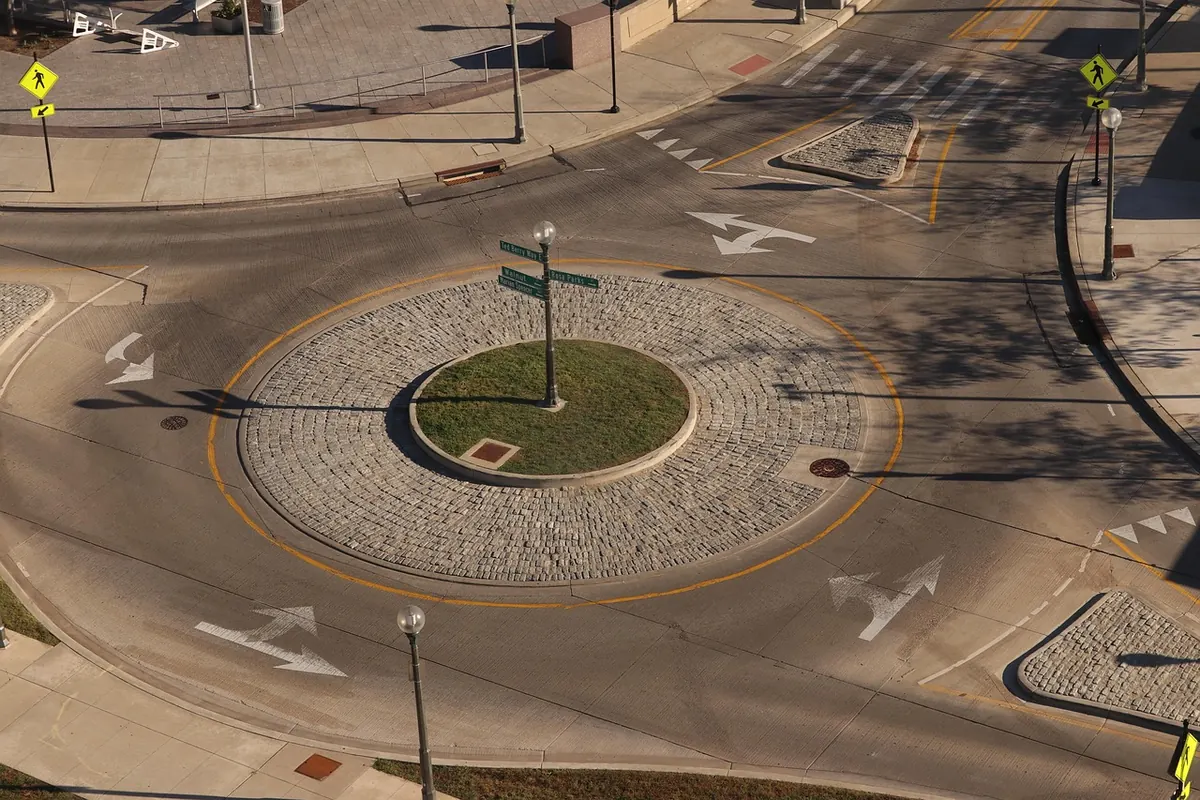
The textured apron around the center island exists for one reason: so the rear wheels of long vehicles can roll over it without hitting the island. Driving a car across it isn't a smoother line. It puts you closer to the center than you need to be, chews up a surface built for occasional heavy loads, and startles whoever is in the lane beside you. Stick to the paved lane, leave the apron alone, and don't clip the middle island either.
Most of what goes wrong at the new roundabout comes from habit rather than carelessness. A driver who has spent thirty years treating an intersection as a place to stop has to learn that this one rewards steady, predictable movement. Give the people ahead of you a little patience; a fair number of them are seeing the circle for the third or fourth time. And if you're unsure what a particular sign or pavement marking requires, check with your state or local road authority — rules and markings vary, and the sign in front of you is the authority, not a column.
Photo: GregReese / Pixabay